List of Monumental sculpture projects 2015

  • 1 http://swannbb.blogspot.fr/2015/02/sunday-robot-play.html
  • 2 http://shuengitswannjie.blogspot.fr/2015/02/interactive-reading-room-tea-house-2015.html
  • 3 http://swannbb.blogspot.fr/2014/06/neo-ming-bed-luxembourg.html
  • 4 http://swannbb.blogspot.fr/2013/02/yuzi-paradise-tell-moon.html
  • 5 http://swannbb.blogspot.com/2011/09/12th-changchun-international-sculpture.html
  • 6 http://www.saatchionline.com/Shuen-git

Wednesday, 7 November 2018

"The Human Heart is made of Flesh" 2018, Egypt. (3d printed sculpture for outdoor permanent display)


3d printed sculpture designed for outdoor permanent exhibition for indefinite period.  Location:  Egyptian Desert.  Temperature:  high


Observation of this new material - 3d printing with filaments - for a permanent outdoor display 

As we know PLA could stay outdoor for 2 years or more (no other published data from users) in Europe.  There has been a 4 meter high sculpture printed with normal infill printed as an outdoor sculpture.   And one in Amsterdam as a statue.  (more research to be done)

To know the exact temperature/conditions inside the glass volume we need to use a thermometer.

The upper part is in PET. White lace plate is in PLA. 
As it is an outdoor installation, with a glass enclosure and bottom lighting, it gets very hot inside. 

We could see after one day in the sunlight, the PLA started to warp a little, it demonstrates buckling and gives a flying aspect to the disk. 

The glass covered volume turns into a "solar slow cooking device".
It is very interesting and we will observe how much warping will continue, and would be very good to have results over one years time. 
  How will the "Human Heart is made of Flesh" survive 4 seasons ?  What behaviors will we see?

We already know the traditional materials, metal and stone; glass has been historically tested to with stand sun rays.  However with wood, it is much more delicate.  And with stone, over time, there will be wind etching too.  Soft wood will not last.  Soft stone will be etched by the wind if left outside unprotected.  What kind of new materials we could use to last longer than the traditional ones?  Carbon fiber?  maybe.  :)

Here, I am looking at my first 3d sculpture living in the desert.

I am looking forwards to seeing photos of this Heart over a years time.

Stay tuned!


thermometer -10 to 110

https://www.permabond.com/materials_bonded/4508/
Bonding PET material


All Permabond cyanoacrylate adhesives bond PET when Permabond POP primer is used first.  Permabond 105 and 2050 provide the highest strength.  Cyanoacrylates are often desired due to the fast set times, however, they provide poor resistance to polar solvents.  They do provide good resistance to non-polar solvents.
The temperature resistance of both the TA4610 and cyanoacrylates exceed the temperature resistance of PET.
UV curable adhesives and two-part epoxies such as ET515 or modified epoxy such as MT3809 bond PET that has been flame, corona, or plasma treated.

Tips for surface preparation and bonding:

For untreated PET there are several options.
  1.  Bond as received with Permabond TA4605 or TA4610
  2. Prime with Permabond POP and use a cyanoacrylate adhesive.  Note that POP only increases adhesive when using a cyanoacrylate, therefore it won’t increase adhesion of other adhesive types.
  3. Flame, corona or plasma treat the PET surface.  After treatment, most adhesives types will provide some adhesion.
Properties of PET
  • Surface energy: 44mJ/m²
  • Maximum service temperature: 70°C - means dont put boiling water into pet bottles, no above 70°C in contact w material
  • Melting temperature: 250°C
PET Uses

  • Packaging, plastic bottles
  • Woven materials such as sailcloth
  • Disposable medical devices
  • Films and wraps

    To determine the best specific adhesive to bond PET in your application, please provide some detail to our technical team and our adhesive advisors will get back to you with a recommendation.

One of the Curators:  Marion Fromlet

At Night, the robot inside the heart throws off green light, incandescent.


109 Artists, "Revival of Humanity Monument", Sharm-el- Sheik  2018


Tuesday, 30 October 2018
"The Human Heart is made of Flesh, Robots got one, and you? " Ancient Chinese wisdom

Updated photo  4Dec2018 - blue suede shoes 12jan2019

(updated blue suede shoes version -)


Add caption


F​or the collective creation of​ Reviving humanity memorial sculpture​ project.Symposium of World Youth Forum​2018, Sharm el Sheikh, Egypt.
A Heart programmed with Ancient Chinese wisdom from Hong Kong.
"The Human Heart is made of Flesh, Robots got one, and you? " 
The Heart absorbs sunlight in the day and glows fumato style in the night.
Artist : Shuengit Natasha Chow 2018. Sharm el Sheik, Egypt
photos of glowing heart by Rosana Martinez.

“人心肉造 ,機器人也有一個,你呢?”
这个人心白天吸收陽光, 入夜隨隨發出霧似的柔光。
藝術家:Shuengit Natasha Chow 2018 周旋捷.
Sharm el Sheik,埃及
攝影 : Rosana Martinez 發光的心


More:


Monday, 17 September 2018
indigo vegetal dye from yilan, taiwan.

indigo blue ~ fish scale pattern ~ vegetal dye from YiLan Taiwan . Beautiful day ~ but forgot to take pics.  Next time!

How long could you keep a vat of dye? 6 months or so, you could add fructose for ph balance - details here

Thursday, 13 September 2018
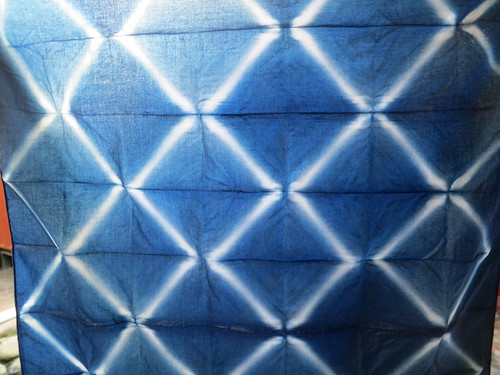
蓝染絲 indigo shiboro tie dye on silk shirt made at e-textile summer camp 2017.

蓝染絲 indigo shiboro tie dye on silk shirt made at e-textile summer camp 2017, France.


Industrial tie dye using shiboro method - demonstrated by french specialist who learnt it from Japanese traditional craftsmen - I made at e-textile summer camp 2017.  France


Ready to wear qipao from Friendship store, arts and crafts - in Beijing 1984

Indigo tie dye - worn 2018


vintage chinese qipao, industrial print


===


http://etextile-summercamp.org/2017/summercamp/indigo-dye-workshop/
Indigo Dye Workshop


Indigo Dye Workshop


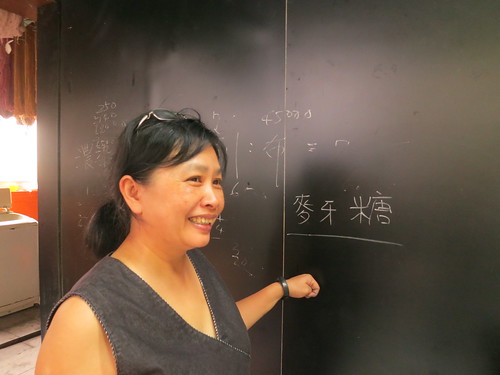
Teacher: Meichi
Location: Li-han Studio
 
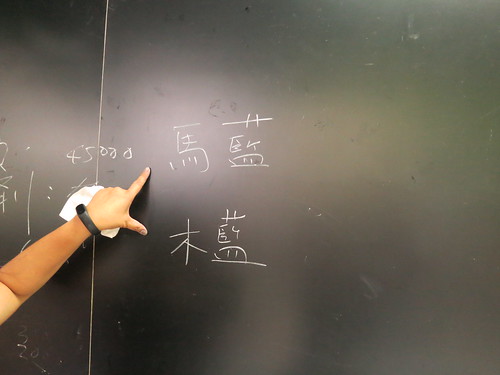
In Taiwan, there are few kinds of Indigo used for dyeing. There are 馬藍 (ma-ai) and 木藍 (ki-ai) as most common kinds. 翡藍 is used in Korea and Japan, and it has greenish blue than 馬藍. Meichi is growing 馬藍 (ma-ai) and she makes her own indigo paste out of it. We used 馬藍 (ma-ai) bath from her in this workshop.
 
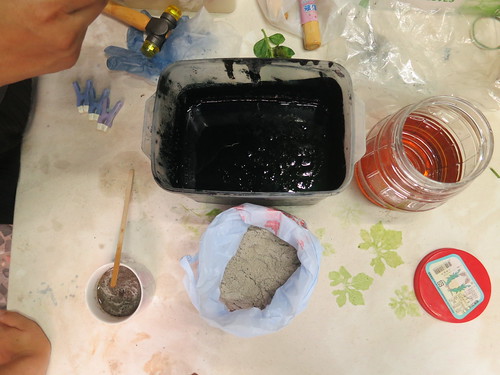
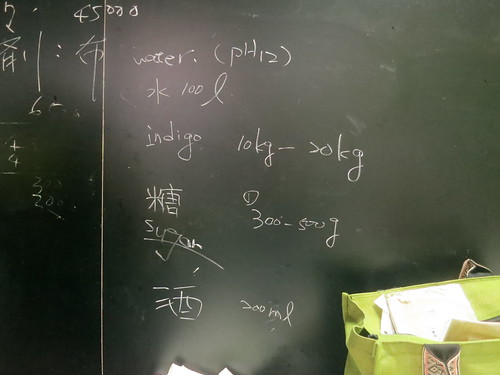
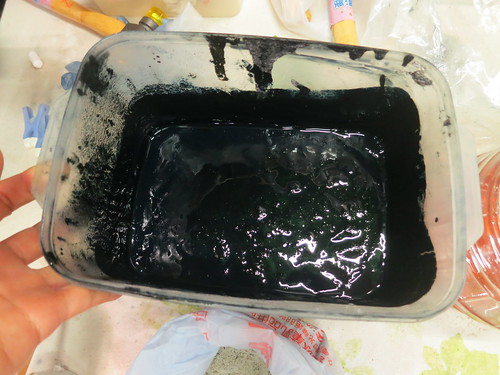
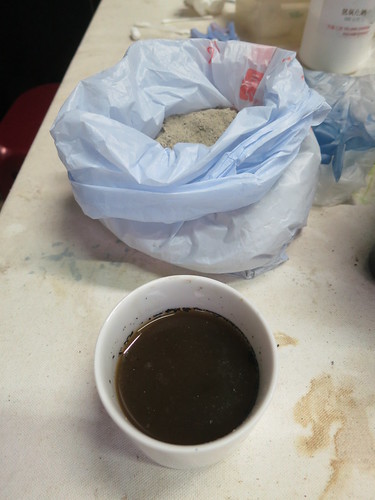
This is what she uses to make her indigo bath. Indigo leaves soaking in water for 30 hours. Then take out the water and your indigo paste is ready. For 10-20 kg of indigo paste, she adds 100 L water, 300-500 g sugar (syrup or honey, this is to feed the fermentation process for the indigo) and 200 ml of sake (rice wine, liquor). Depending on the color you can add more sugar (200 gr.). She then adds Supernatant of ash water (from coles, black wood, or NaOH = chemical version of ashes) to keep the bath in high pH. The bath should be pH12 and she adjusts this by adding ash water or sake. Mix this pot every day for 5 minutes for the next 3 to 7 days. Then your indigo vat is ready.
 
Indigo paste and the ash water
 
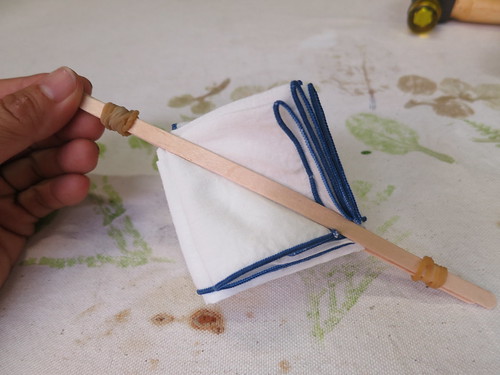
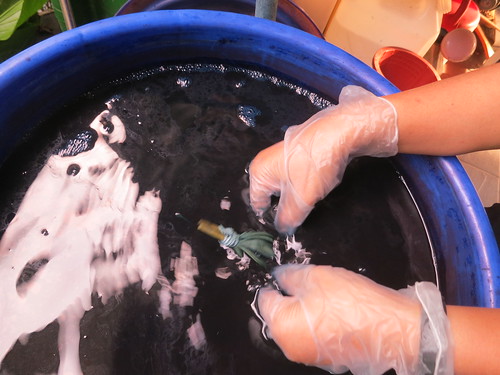
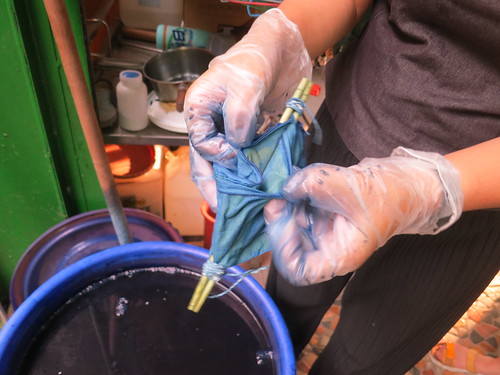
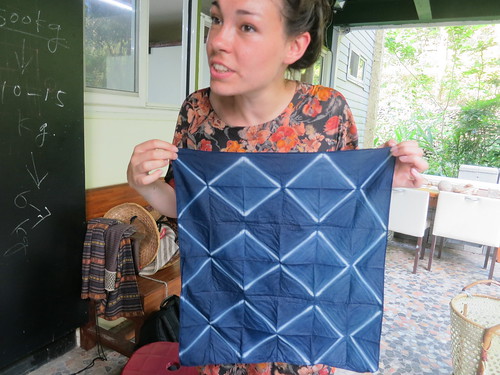
Fold the fabric (cotton, linen, natural fiber fabric) into a square piece and bind it with wooden stick and thread or rubber band. Dip it into Indigo bath for 3 min. Open up each fold in the bath so the indigo liquid goes into the details of the fabric folds.

After the 3 minutes, take out the fabric from Indigo bath and open every fold to air them. When the indigo dye is exposed to air (oxygen) it turns its color from yellow to blue.
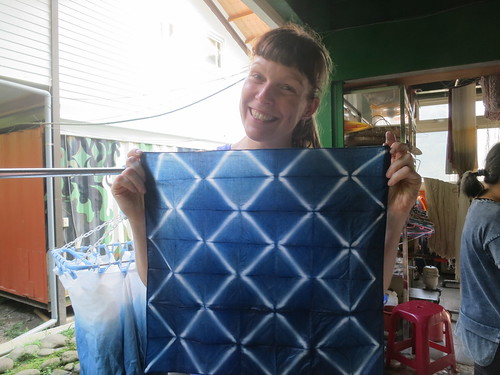
Repeat this process for 5 times. In professional dying, they will repeat this for 15 times.
 

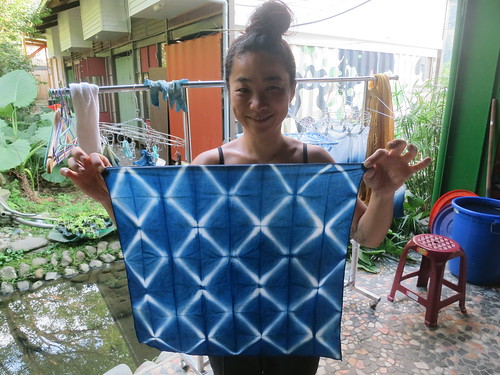
Even though we fold it in the same way and dyed the same amount of time, it all came out differently.
 
 
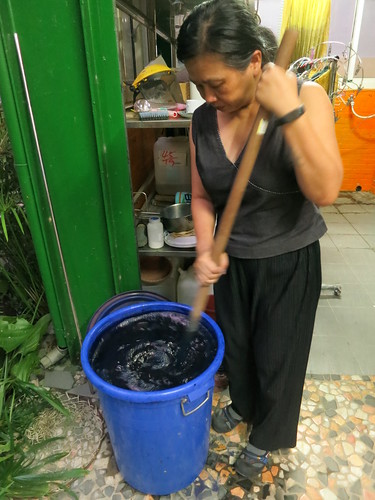
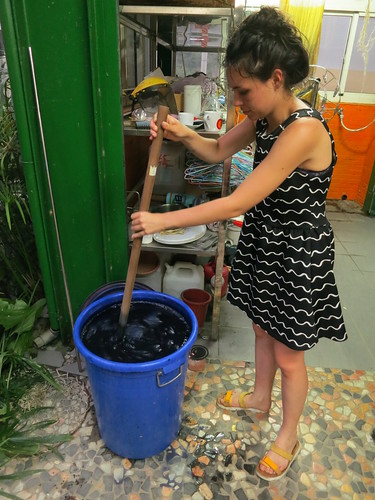
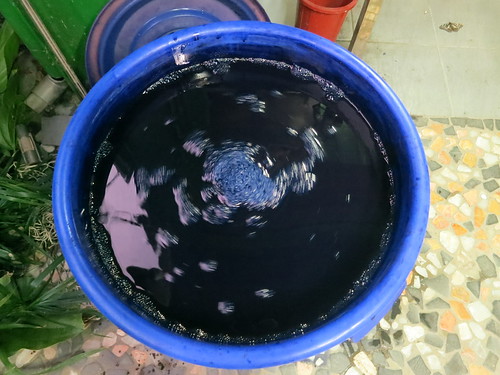
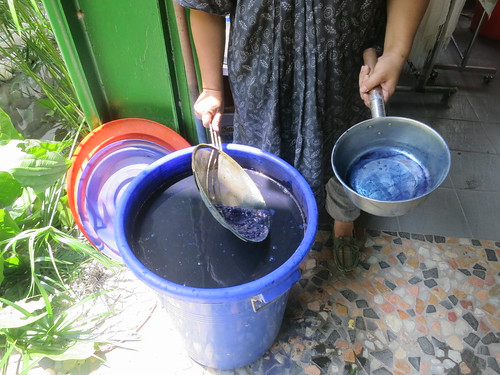
After using the indigo bath before finishing the work, you need to air the bath by mixing it with long wooden stick. we did this for 5min or so, and as Meichi finalizes the mixing process, you can see the “bubble flower” in the middle. The next time you use the bath, you scoop out the bubble with a sieve. You can use this to dye with a brush. In old days, this was used as a blue color by painters.
Here is another version of indigo making: https://thekindcraft.com/the-process-indigo-from-plant-to-paste/

Saturday, 1 September 2018

On the Track of Robert van Gulik - a documentary - director Rob Romboult

On the Track of Robert van Gulik : director Rob Romboult

On the trailer, we see beautiful nostalgic latino music and very "looking back" type of images - with vintage flow of texts - very interesting.  It goes soft on the Chineseness of the subject.  But the full length film is different - the music is even better - and of course it is guqin slow interior spiritual music - beautiful long tones similar to human voices.

I have read most of Robert van Gulik's books except the paper back detective novels.  I had seen the covers of these books - they seemed like pulp fiction with an esoteric twist to me.  Especially when I looked at the quality of the cover drawings - always like a copy of someone who doesnt know how to draw well but did manage to finish with great passion.  Someone who is so passionate about "copying" old graphic styles of the Chinese drawings but could only manage a kind of rough blocking in all the pieces but the brush work are very rough and no variations in the lines.  Just like a foreigners calligraphy for Chinese brush work - both writing and drawing - awkward but great passion and much pride in the finished product.  Actually this is not so bad at all!    These are fun illustrations and not fine art work - very fitting for detective novels.  That is why I have never read them.

note:  At 1:07:14, a researcher reported she found the original drawings - they were drawn on tracing papers - like architects transparent drawings - tracings from other books, images which he adapted for his own use.  See, that is why the lines were like school boy drawings because they were traced - not brush work.  Joy of making drawings piecing images together.

However; I soon discovered his body of research scholarly works in guqin and wood block prints.  This throws an entirely new light on his pulp fiction covers.  It adds a kind of amateur charm to them.  So I read a couple of these detective novels too.  What was amazing was the introduction to the background of the detective novels was as thick as the novel itself!  The introduction was about the judicial system in china and how a criminal is put to the test to see whether hes guilty or not.  This part is also more interesting than the novel itself.  

Then I think; how could anyone have so much time to do these things and on top of all this is a full time diplomat!!  He must be someone a bit like Renoir; who is also a diplomat; and master painter.  And apparently he also negotiated well for the business of painting too.

Then; I think maybe diplomat jobs in those days were a special kind of position?  You dont have to do /cannot do/ will not be realistically qualify for the job - its not at all the same kind of job like today where we all have to go do entrance exams to enter the government positions but they depend on entirely other type of knowledge, qualities,  contextual conditions and expertise?  He was also every now and then - a spy!  Not surprising but people today have to be trained to be spy - what a wonderful life; you can do so many things be in so many roles.

While some diplomat stays diplomat there are other diplomats too - and they use their time to study erotic sex life of ancient chinese people?  And write detective novels - make special curious bonsai so on so forth.

I am so happy to see more references and sources of his work; and more of other peoples work on his work.

This film adds visual attractiveness, giving life through moving images to the grand master of interestingness - Master van Gulik.


More coming after reviewing the film, am v excited to view the film but want to view it slowly.  First I listen to the sound track without seeing the film; then I will watch it a second time.
===
I will have to watch it again - v rich informative film.
===


On the Track of Robert van Gulik


LikeShow More Reactions
Comment

A writer of ancient Chinese detective novels, sexual life in ancient China, a spy, a member of the Chinese literati, Robert van Gulik's story reads like no other sinologist that has ever lived. @onthetrackofrobertvangulik London Youlan Qin Society 倫敦幽蘭琴社 @Marius Marre 


You can watch the full film for free at:
https://vimeo.com/150994641
password:vangulik2016