Sunday, 24 August 2014

Saturday, 23 August 2014
the-10-greatest-pioneers-of-animation-you-should-know-about
http://www.tasteofcinema.com/2014/the-10-greatest-pioneers-of-animation-you-should-know-about/

With a few notable exceptions, such as Walt Disney, The Termite Terrace from Warner Bros., Tex Avery and the duo of Joseph Hanna and Joe Barbera, animation has historically been an art with very little respect from the audience to its creators. Seen for many decades as mere children’s entertainment, animators from around the world and from very different trends have demonstrated that the possibilities of the genre are as infinite as the imagination of its makers.
Even though now animators, such as Sylvain Comet or Bill Plympton, and studios like Pixar and Ghibli have garnered respect and appreciation for its craft, it is important to remember those visionaries that opened doors to thousands of dreamers who wanted to make their paper dreams to come alive.
1. Émile Cohl (1857 – 1938)

Born in Paris in 1858, from very young age he demonstrated a skill for the arts in school. But it would be the chaos brought by the Franco-Prussian war and the subsequent Paris Commune that would guide him, as a vagrant in the streets of Paris, to his two major inspirations: the form of puppetry known as guignol and political cartoons, banned during the rule of Napoleon III, but heavily appreciated in the following Third Republic.
Cohl became a famous cartoonist in the bohemian groups of late 19th century Paris, working in several popular publications. He was thanks to his wit and humor landed on a job creating comical situations for Gaumont, the milestone film company that produced many classic French silence movies, including the serial Les Vampires.
Seeing the success of the scarce animation shorts available at the time among the public, Léon Gaumont commissioned Cohl the task to understand how animation worked, so the studio could produce their own. Cohl figured out the visual illusion while studying it frame by frame.

Cohl premiered his first short, Fantasmagorie, in 1908 and followed it with several works following more or less the same ever-changing dream-like style, with plots generally made up as he drew them, and a rudimentary technique based on making a drawing and then tracing it with a slight modification.
A method he abandoned for the less time-confusing use of cut-out figures with moveable extremities. Despite a wide success, after some personal problems and dissatisfied with the French studios, Cohl migrated to America, specifically Fort Lee, New Jersey where many early film studios were located.
It was in New Jersey where Cohl would invent one of the staples of animation: adapting George McManus’ The Newlyweds comic strip, Cohl made a series of monthly episodes that were denominated “animated cartoons”, thus creating an entire genre of entertainment. Despite the popularity of his work, he faded into obscurity after World War I, in which he returned to France to volunteer, and died at the age of 80 in poverty.
2. Quirino Cristiani (1896 – 1984)

20 years before Walt Disney amazed the world by giving a fairytale animated life, Italy-born Argentinean Quirino Cristiani had premiered in 1917 El Apóstol (The Apostle), a 70 minutes-long political satire made with cutout animation. The film, about the president of Argentina ascending the heavens to clean out Buenos Aires from vice and corruption, only to burn down the city with the thunder of Zeus, is widely regarded as the first animated feature film.
While animation in the United States flourished as farcical vignettes and were regarded as a mere novelty, Cristiani started his career on animation making an accompanying piece for a newsreel made by Fernando Valle, his long-time producer. Valle gave him a book by Émile Cohl to learn the process and proceed to touch, and sometimes poke fun of, world news and events in his productions.
His most ambition production would be done in 1931 with Peludópolis, a political fable where the leaders of Argentina are shown as pirates struggling for the leadership of a boat where for the first time an animated film that included sound.
Nonetheless, a coup d’état during mid-production forced Cristiani to change the plot of the film to present the current government in a heroic manner. Sound, meanwhile, was a achieved with a synchronizing the projection with a record that included dialogue and some songs. The movie was a financial failure that nearly drove Cristiani to bankruptcy.

In 1938, Cristiani was hired to make shorts based on the stories by children’s author Constancio Vigil. The first one was El Mono Relojero (The Watchmaker Monkey) which, despite being well-received by the audience, was the only one produced after Vigil decided to stop the series.
In 1941 Walt Disney travelled to Argentina, where he was shown some productions done by Cristiani and personally met him. Disney offered him a job but Cristiani refused since his own studios, now starting to focus on dubbing and making subtitles, proved very successful.
Sadly, in the 50’s and 60’s two fires destroyed most of Cristani’s oeuvre. Some loose fragments of Peludópolis notwithstanding, the only remain of Cristiani’s work on animation is El Mono Relojero, thanks to Constancio Vigil, who was given a copy as a gift.
3. Lotte Reiniger (1899 – 1981)

When Charlotte Reiniger, born in 1899, was a child she had one major fascination: silhouette puppetry. Young Lotte would even put up puppet shows for her friends and relatives, but while many grow out dreams and passions from childhood, Reiniger cultivated hers with the influences of theater and cinema.
She made short films, sequences and intertitles for silent movies (including Fritz Lang’s Die Nibelungen) and in 1926 she became the first woman to direct a feature animation film with The Adventures of Prince Achmed, the oldest surviving animated film, based on several stories from The Arabian Nights.

In 1923 Louis Hagen, a young Berlin banker who was a fan of Reiniger and had bought a large quantity of film stock as a precaution to the inflation that was hitting Germany, approached Reiniger to produce a film on any subject of her interest. For the next three years Reiniger and her co-animator and husband Carl Roch, worked on a studio built above Hagen’s garage on his house in Potsdam.
Prince Achmed was the only feature film by Reiniger. Despite World War II forcing her to move in several countries through Europe until finally setting in England, she dedicated the rest of her 60 years of career in animation to do dozens of shorts, mostly adaptations of fairytales but also notably several fragments of opera by Mozart and Bizet that were lauded by her friend, French filmmaker Jean Renoir, who regarded her entire body of work as “a visual expression of Mozart’s music”.
4. Ub Iwerks (1901 – 1971)

In 1919 Ub Iwerks, a commercial artist of Kansas City born from Frisian immigrants met a colleague by the name of Walt Disney. They two quickly became friends and when Disney decided to try his hand in animation, Iwerks, a skilled draughtsman, was his first employee. Despite some setbacks, the two moved to Los Angeles in the early 20’s to work in the Alice comedies, a series loosely based on Alice in Wonderland that mixed elements of animation and live-action.
Together they created Oswald The Lucky Rabbit, Disney’s first cartoon character with Iwerks entirely animated the first short. When their distributor, Universal Studios, took away the character and most of Disney’s staff, Iwerks remained with his friend. To replace the character they came up with a mouse called Mickey Mouse, whith Iwerks as its chief animator, making shorts like Steamboat Willie where they would set the foundations of the Disney style.

Nonetheless some crashes between Iwerks and Disney, including the feeling that Disney was keeping most of the credit, led Iwerks to abandon the company and try his hand on starting in own studio in the early 30’s. It was a failure and Iwerks went through many animation studios, where he notably directed two Daffy Duck and Porky Pig cartoons, before returning to Disney.
Ub Werks spent the rest of his career focusing on special effects for cinema. He worked on Song of the South and Mary Poppins, the latter which would earn him his only Oscar, contributed to Disneyland rides such as The Haunted Mansion and Pirates of the Caribbean and, outside Disney, made some of the special effects for Alfred Hitchcock’s The Birds. Walt and Ub, despite previous falling outs and something of an unequal professional relationship, remained lifelong friends.
5. Willis O’Brien (1886 – 1962)

At age 11, Willis O’Brien left his home in Oakland, California to become a cattle rancher. Along the years, he would end up working as a cowboy, a boxer, a railroad worker, a jockey, a bartender, a cartoonist and as a guide for paleontologists. It was in this job that he would develop a lifelong fascination with dinosaurs.
In his spare time O’Brien sculpted figures out of clay and with the help of a borrowed camera, he made a 90-second long stop-motion short about a dinosaur and a caveman. He got a $5,000 budget to expand it into a film, starting a career of over 45 years.
After making a series of short films for the Thomas Edison Company among other things, O’Brien was commissioned to make one of his most emblematic films: 1925’s The Lost World, an adaptation of Sir Arthur Conan Doyle’s novel from the same name. This time, O’Brien employed Mexican-American sculptor Marcel Delgado to make more realistic figures out of rubber skin with metal skeletons inside to facilitate movement, a technique standard in stop-motion today.

Despite working on the preproduction of a series of cancelled projects, the head of RKO was so impressed with the test footage that he assigned O’Brien in what not only would become his most remembered work on special effects, but also one of cinema’s most iconic movies: the 1933 film King Kong.
Through the years, O’Brien worked on several productions such as Citizen Kane, in which he famously reused the pterodactyls from Son of Kong in the camping scene, Mighty Joe Young, earning him his only Oscar in 1950, and his last movie It’s a Mad, Mad, Mad, Mad World, in which he animated some characters dangling from a fire truck ladder in the film’s climax.
Although he spent time developing numerous pet projects, none of these were accepted by the studios. Some include: King Kong vs. Frankenstein, Valley of the Mist, about a Mexican boy who defends his village from a giant dinosaur, and Gwangi, about cowboys falling through a cave to prehistoric times. His protégé Ray Harryhausen would combine the latter two to make Valley of the Gwangi in 1969.
Read more at http://www.tasteofcinema.com/2014/the-10-greatest-pioneers-of-animation-you-should-know-about/#2FpHLuPjEZvPEMdx.99
The 10 Greatest Pioneers of Animation You Should Know About
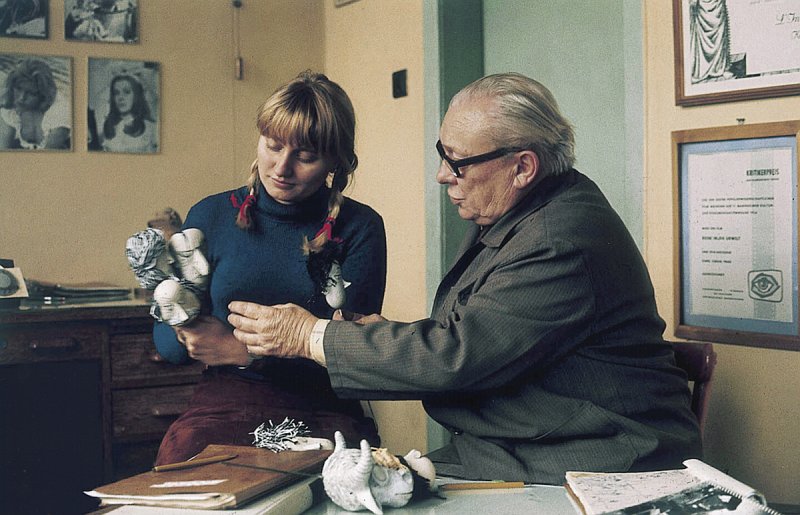
With a few notable exceptions, such as Walt Disney, The Termite Terrace from Warner Bros., Tex Avery and the duo of Joseph Hanna and Joe Barbera, animation has historically been an art with very little respect from the audience to its creators. Seen for many decades as mere children’s entertainment, animators from around the world and from very different trends have demonstrated that the possibilities of the genre are as infinite as the imagination of its makers.
Even though now animators, such as Sylvain Comet or Bill Plympton, and studios like Pixar and Ghibli have garnered respect and appreciation for its craft, it is important to remember those visionaries that opened doors to thousands of dreamers who wanted to make their paper dreams to come alive.
1. Émile Cohl (1857 – 1938)

Born in Paris in 1858, from very young age he demonstrated a skill for the arts in school. But it would be the chaos brought by the Franco-Prussian war and the subsequent Paris Commune that would guide him, as a vagrant in the streets of Paris, to his two major inspirations: the form of puppetry known as guignol and political cartoons, banned during the rule of Napoleon III, but heavily appreciated in the following Third Republic.
Cohl became a famous cartoonist in the bohemian groups of late 19th century Paris, working in several popular publications. He was thanks to his wit and humor landed on a job creating comical situations for Gaumont, the milestone film company that produced many classic French silence movies, including the serial Les Vampires.
Seeing the success of the scarce animation shorts available at the time among the public, Léon Gaumont commissioned Cohl the task to understand how animation worked, so the studio could produce their own. Cohl figured out the visual illusion while studying it frame by frame.
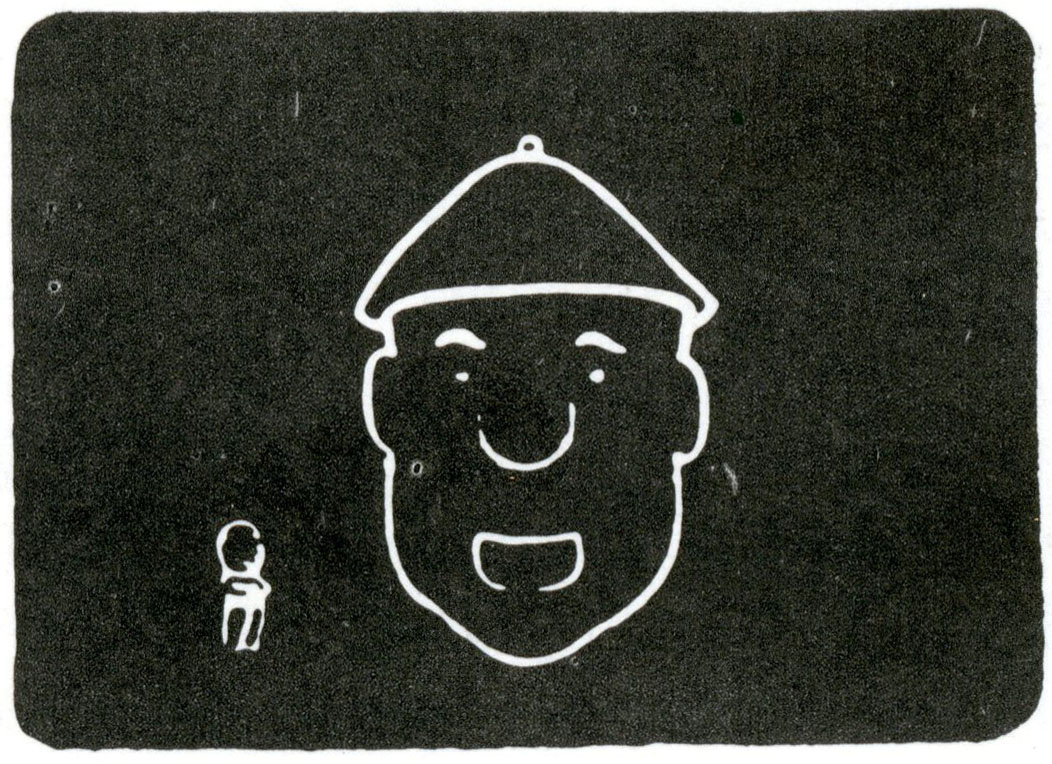
Cohl premiered his first short, Fantasmagorie, in 1908 and followed it with several works following more or less the same ever-changing dream-like style, with plots generally made up as he drew them, and a rudimentary technique based on making a drawing and then tracing it with a slight modification.
A method he abandoned for the less time-confusing use of cut-out figures with moveable extremities. Despite a wide success, after some personal problems and dissatisfied with the French studios, Cohl migrated to America, specifically Fort Lee, New Jersey where many early film studios were located.
It was in New Jersey where Cohl would invent one of the staples of animation: adapting George McManus’ The Newlyweds comic strip, Cohl made a series of monthly episodes that were denominated “animated cartoons”, thus creating an entire genre of entertainment. Despite the popularity of his work, he faded into obscurity after World War I, in which he returned to France to volunteer, and died at the age of 80 in poverty.
2. Quirino Cristiani (1896 – 1984)

20 years before Walt Disney amazed the world by giving a fairytale animated life, Italy-born Argentinean Quirino Cristiani had premiered in 1917 El Apóstol (The Apostle), a 70 minutes-long political satire made with cutout animation. The film, about the president of Argentina ascending the heavens to clean out Buenos Aires from vice and corruption, only to burn down the city with the thunder of Zeus, is widely regarded as the first animated feature film.
While animation in the United States flourished as farcical vignettes and were regarded as a mere novelty, Cristiani started his career on animation making an accompanying piece for a newsreel made by Fernando Valle, his long-time producer. Valle gave him a book by Émile Cohl to learn the process and proceed to touch, and sometimes poke fun of, world news and events in his productions.
His most ambition production would be done in 1931 with Peludópolis, a political fable where the leaders of Argentina are shown as pirates struggling for the leadership of a boat where for the first time an animated film that included sound.
Nonetheless, a coup d’état during mid-production forced Cristiani to change the plot of the film to present the current government in a heroic manner. Sound, meanwhile, was a achieved with a synchronizing the projection with a record that included dialogue and some songs. The movie was a financial failure that nearly drove Cristiani to bankruptcy.
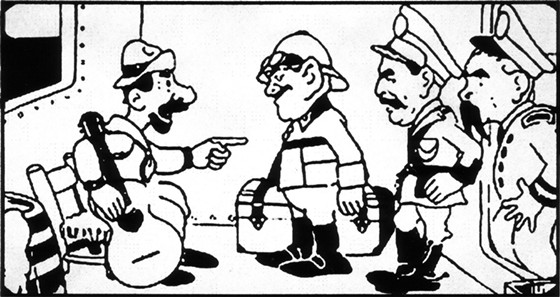
In 1938, Cristiani was hired to make shorts based on the stories by children’s author Constancio Vigil. The first one was El Mono Relojero (The Watchmaker Monkey) which, despite being well-received by the audience, was the only one produced after Vigil decided to stop the series.
In 1941 Walt Disney travelled to Argentina, where he was shown some productions done by Cristiani and personally met him. Disney offered him a job but Cristiani refused since his own studios, now starting to focus on dubbing and making subtitles, proved very successful.
Sadly, in the 50’s and 60’s two fires destroyed most of Cristani’s oeuvre. Some loose fragments of Peludópolis notwithstanding, the only remain of Cristiani’s work on animation is El Mono Relojero, thanks to Constancio Vigil, who was given a copy as a gift.
3. Lotte Reiniger (1899 – 1981)

When Charlotte Reiniger, born in 1899, was a child she had one major fascination: silhouette puppetry. Young Lotte would even put up puppet shows for her friends and relatives, but while many grow out dreams and passions from childhood, Reiniger cultivated hers with the influences of theater and cinema.
She made short films, sequences and intertitles for silent movies (including Fritz Lang’s Die Nibelungen) and in 1926 she became the first woman to direct a feature animation film with The Adventures of Prince Achmed, the oldest surviving animated film, based on several stories from The Arabian Nights.

In 1923 Louis Hagen, a young Berlin banker who was a fan of Reiniger and had bought a large quantity of film stock as a precaution to the inflation that was hitting Germany, approached Reiniger to produce a film on any subject of her interest. For the next three years Reiniger and her co-animator and husband Carl Roch, worked on a studio built above Hagen’s garage on his house in Potsdam.
Prince Achmed was the only feature film by Reiniger. Despite World War II forcing her to move in several countries through Europe until finally setting in England, she dedicated the rest of her 60 years of career in animation to do dozens of shorts, mostly adaptations of fairytales but also notably several fragments of opera by Mozart and Bizet that were lauded by her friend, French filmmaker Jean Renoir, who regarded her entire body of work as “a visual expression of Mozart’s music”.
4. Ub Iwerks (1901 – 1971)
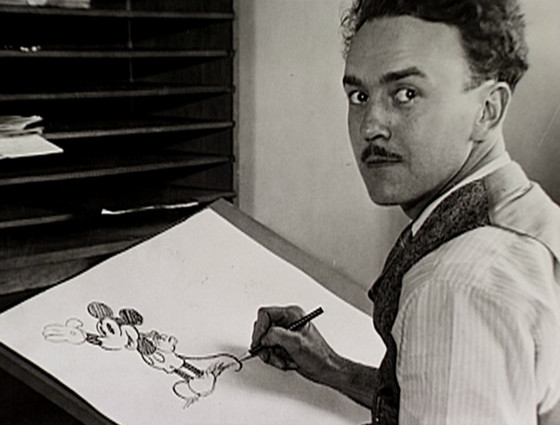
In 1919 Ub Iwerks, a commercial artist of Kansas City born from Frisian immigrants met a colleague by the name of Walt Disney. They two quickly became friends and when Disney decided to try his hand in animation, Iwerks, a skilled draughtsman, was his first employee. Despite some setbacks, the two moved to Los Angeles in the early 20’s to work in the Alice comedies, a series loosely based on Alice in Wonderland that mixed elements of animation and live-action.
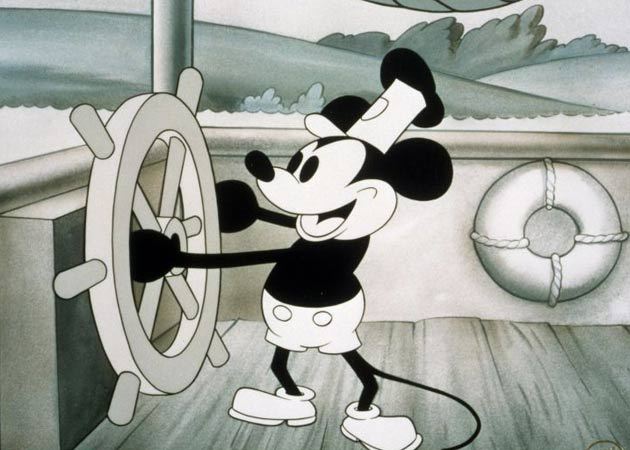
Together they created Oswald The Lucky Rabbit, Disney’s first cartoon character with Iwerks entirely animated the first short. When their distributor, Universal Studios, took away the character and most of Disney’s staff, Iwerks remained with his friend. To replace the character they came up with a mouse called Mickey Mouse, whith Iwerks as its chief animator, making shorts like Steamboat Willie where they would set the foundations of the Disney style.
Nonetheless some crashes between Iwerks and Disney, including the feeling that Disney was keeping most of the credit, led Iwerks to abandon the company and try his hand on starting in own studio in the early 30’s. It was a failure and Iwerks went through many animation studios, where he notably directed two Daffy Duck and Porky Pig cartoons, before returning to Disney.
Ub Werks spent the rest of his career focusing on special effects for cinema. He worked on Song of the South and Mary Poppins, the latter which would earn him his only Oscar, contributed to Disneyland rides such as The Haunted Mansion and Pirates of the Caribbean and, outside Disney, made some of the special effects for Alfred Hitchcock’s The Birds. Walt and Ub, despite previous falling outs and something of an unequal professional relationship, remained lifelong friends.
5. Willis O’Brien (1886 – 1962)

At age 11, Willis O’Brien left his home in Oakland, California to become a cattle rancher. Along the years, he would end up working as a cowboy, a boxer, a railroad worker, a jockey, a bartender, a cartoonist and as a guide for paleontologists. It was in this job that he would develop a lifelong fascination with dinosaurs.
In his spare time O’Brien sculpted figures out of clay and with the help of a borrowed camera, he made a 90-second long stop-motion short about a dinosaur and a caveman. He got a $5,000 budget to expand it into a film, starting a career of over 45 years.
After making a series of short films for the Thomas Edison Company among other things, O’Brien was commissioned to make one of his most emblematic films: 1925’s The Lost World, an adaptation of Sir Arthur Conan Doyle’s novel from the same name. This time, O’Brien employed Mexican-American sculptor Marcel Delgado to make more realistic figures out of rubber skin with metal skeletons inside to facilitate movement, a technique standard in stop-motion today.

Despite working on the preproduction of a series of cancelled projects, the head of RKO was so impressed with the test footage that he assigned O’Brien in what not only would become his most remembered work on special effects, but also one of cinema’s most iconic movies: the 1933 film King Kong.
Through the years, O’Brien worked on several productions such as Citizen Kane, in which he famously reused the pterodactyls from Son of Kong in the camping scene, Mighty Joe Young, earning him his only Oscar in 1950, and his last movie It’s a Mad, Mad, Mad, Mad World, in which he animated some characters dangling from a fire truck ladder in the film’s climax.
Although he spent time developing numerous pet projects, none of these were accepted by the studios. Some include: King Kong vs. Frankenstein, Valley of the Mist, about a Mexican boy who defends his village from a giant dinosaur, and Gwangi, about cowboys falling through a cave to prehistoric times. His protégé Ray Harryhausen would combine the latter two to make Valley of the Gwangi in 1969.
Read more at http://www.tasteofcinema.com/2014/the-10-greatest-pioneers-of-animation-you-should-know-about/#2FpHLuPjEZvPEMdx.99
More Secondlife- Real Life stories. Taking mind off a real life pain disorder
Second Life Saves Me from a Real Life Pain Disorder (Comment of the Week)

This open thread on why people continue to stay in Second Life is really great, topped in my view by this answer from an SLer named Cube Republic:
I found SL just as I was diagnosed with a rare pain disorder, reputedly the most painful a human can endure. Creating in SL and living a fantasy helps me forget the reality of my existence, which is painful. I can work around my condition and make money to boot. I have a lot to be grateful to SL for. I learnt 3D, first prims, then sculpts and now mesh through my engagement with the platform. I really hope SL2 lives up to my hopes. I consider this now my life's work, and I hope my work makes other people happy.This is awesome in many ways, and when I asked Cube to tell more more about this disorder, discovered there was still more to this story that made it even more awesome:
Like I said, even awesomer. And happy anniversary wishes to Cube and spouse.
Avatar profile image courtesy of Cube. Please share this post:
Tuesday, 19 August 2014
ars electronica 2014: Kim Yong Hun+Shin Seung Back featured artists
creativity, catalysts, community, collaboration, communication, content, commons, competition, chaos, culture, cooperation, crossover, cross-disciplinarity, capability, capacity, capital, craving, caution, certainty, confidence, challenge, choice, citizens, clouds, crowds, clusters, code, coexistence, cohesion, coincidence, cynicism, cacophony, commitment, compromises, consideration, coordination, copyright, copyleft, correlation, courtesy, craziness, credibility, criticism, cruelty, cubicles, cookies, caffeine, cognition, china, cumulation, culmination, cyberspace, cyber-arts …
C ... what it takes to change
C … what it takes to change
The 2014 Ars Electronica Festival is set for September 4-8.This year’s theme is “C … what it takes to change,” an inquiry into the prerequisites and framework conditions necessary to enable social innovation and renewal to emerge and make an impact. The focus will be on art as catalyst. The in-depth elaborations, lively discussions and bold provocations will feature, as usual, artists, scholars and scientists from all over the world—renowned intellectuals confronted by young contrarians, top experts encountering interested laypersons, the pioneers of the Digital Revolution face to face with the shooting stars of today’s media art scene. From September 4th to 8th, Ars Electronica will once again be a setting for reciprocal exchange and networking, a one-of-a-kind forum in which perspectives and opinions are negotiated and presented in the form of speeches, artistic installations, performances and interventions.---
http://www.aec.at/aeblog/en/2014/08/18/featured-artists-ars-electronic-2014/
Kim Yong Hun+Shin Seung Back featured artists
How does technology affect human lives?
“Cloud Face” is a collection of cloud images that are recognized as human face by a face-detection algorithm.
In “Cat or Human” human faces are recognized as a cat face by a cat face-detection algorithm and vice versa.
The “Nonfacial Mirror” avoids faces.
CAPTCHA has originally been developed to distinguish computers from humans. It asks the user to type text from a distorted image. “CAPTCHA Tweet” is an application that users can post tweets as CAPTCHA.
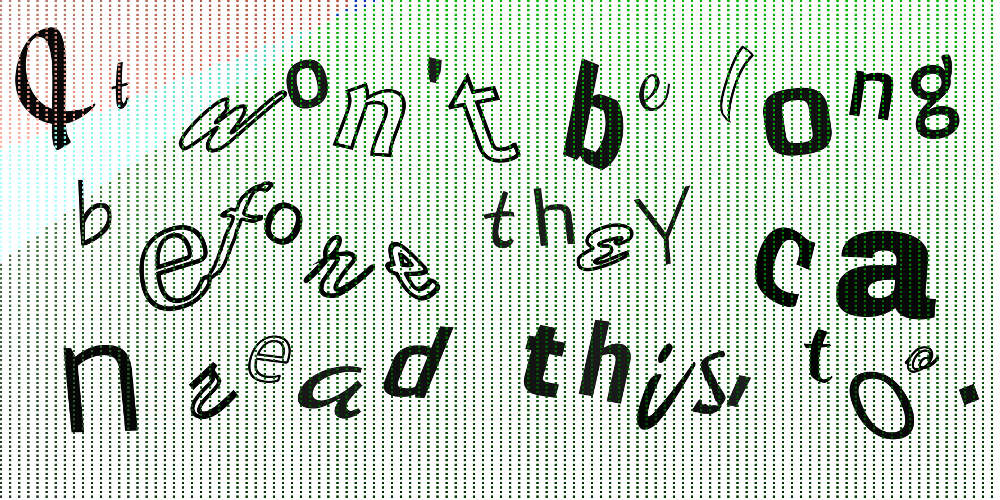
“FADTCHA” (FAce Detection Turing test to tell Computers and Humans Apart) presumes a reverse situation. It requires a user to find a face in an image, which is visible only to computers. This test can pick out non-computers. Why can’t people see the faces in the images? What do you think is different to “Cloud Face”?

A Million Seasons is an attempt to describe images of four seasons with a million photos each. A million Flickr photos tagged ‘spring’ are collected, and each photo is turned into one pixel with an average color. The one million pixels from one million photos compose an image of Spring. The images of the rest of the seasons are created the same way. Have you imagined the images like this?

A Mouse click symbolizes a special moment in time we spend with computers. In “Click” a day of our computer mediated life has been recorded by capturing a screen shot of a desktop every time a clicke was done. Why is a mouse click such a special moment in time we spend with computers?
Shin Seung Back: A mouse click is important because we explore our computer mediated life by repeating it to trigger particular actions. We thought recording the repetitive behaviour can show an aspect of the life. In the same manner, one may try to record a specific eye movement or body gesture.If you want to get an idea of this extraordinary work itself you can do that at the 2014 Ars Electronca Festival, from 4 to 8 September. The projects of Shinseungback Kimyonghun can be seen at Ars Electronica Center, in conjunction with the exhibition “Out of Control”, at Arkade, at Barschneiderei and in conjunction with the exhibition of the Future Innovators Summit at Akademisches Gymnasium Linz. More information: http://www.aec.at/c/en/featured-artists/
The stroll 2003 -

The Stroll
(2003) ***half
"Progulka"
(original title)
-
Very charming film, one continuous shot of a mysterious attractive girls walk through moscow - the story behind what we see. Clever plot and very touching. A fresh type of poetic, courageous romance unlike the stereotypical sugar sweet romance we see in American films.
Sunday, 17 August 2014
mulit color silk strings - art made from books
包邮 全真丝古琴弦 丝弦纯蚕丝手工制作 彩色 清鸾惊鸿 套装
彩色丝弦

-------------------------------
Art made from Books
Art Made from Books: Altered, Sculpted, Carved, Transformed (Anglais) Relié – 1 septembre 2013
Subscribe to:
Posts (Atom)